

One year after the world’s first social media ban for kids, the results are in. And Europe seems to have learned from them.
Two months ago, I took a side
In December 2025, Australia became the first country to ban children under 16 from social media. Facebook, Instagram, TikTok, Snapchat, YouTube and others had to remove young users and stop new ones from signing up.
On September 9, 2026, I wrote that banning kids won’t stop them. It will only push them underground. My point was simple: as a parent, I would rather know where my children are online, and have the tools to notice when something goes wrong, than have them move to new places that I don’t know and can’t see.
Since then, two things happened. The ban is now almost a year old, and the data keeps pointing the same way. And just eight days after my article, the European Union looked closely at Australia and chose a different path.
A quick note before I go on: I work at PureSight, a company that builds online safety tools for parents. So yes, I have a point of view. That is exactly why this article leans on public numbers from regulators and researchers, not on my opinion alone.
What actually happened in Australia
The headline number sounds impressive. Around 4.7 million under-16 accounts were removed, deactivated or restricted in the first three months, according to the eSafety Commissioner. But that number counts accounts, not children. Many kids had more than one account, and some simply opened new ones.
But look closer:
- Most teens are still there. A study by Australia’s own eSafety Commissioner, covering more than 4,000 families, found that social media use among under-16s dropped only from 86% to 81% three months after the ban started. The share with an account fell from 52% to 42%. In eSafety’s own words, most kids who had accounts before the ban were able to keep them or create new ones.
- The front door was never really locked. Testers from the firm that ran the government’s own age-check trial opened 50 accounts across nine of the ten platforms covered by the law, simply typing in an age of 16. Not one of those nine platforms asked for proof of age.
- The government is now pushing harder. Australia doubled the maximum fine and warned platforms they could face court action for not complying.
To be fair, the ban was not useless. It started an important national conversation. And one study suggested it may work better at delaying very young children, who have not started using social media yet, than at removing teenagers who already use it. That is a real benefit, and I don’t want to dismiss it.
But for a 13- or 14-year-old who already has an account, the ban mostly changed one thing: they are now somewhere they are not supposed to be.
The hidden cost: kids stop asking for help
This is the part that worries me most, and it rarely makes the headlines.
When a child uses an app that is “allowed,” and something bad happens (a stranger sends a creepy message, a group chat turns cruel, someone shares a photo they shouldn’t), the child can go to a parent and say, “Look what happened.”
When a child uses an app that is forbidden, that same conversation becomes much harder. Telling a parent about the problem means admitting they broke the rule. Many kids will choose to stay quiet.
A ban does not remove the risk. It removes the adult from the picture. And the adult is often the most important safety feature a child has.
There is also the question of where kids go. We saw this in Australia in the very first days. As the ban started, lesser-known apps like Lemon8 and Yope jumped to the top of the download charts, and the government later added Lemon8 to the ban. These are places where parents have less visibility, and platforms have fewer safety teams, not more.
Europe chose a different path
On 17 September 2026, the European Commission proposed the EU KIDS Act. The European Parliament had called for a minimum age of 16, close to Australia’s model. The Commission chose a different path. It is still a proposal: the Parliament and member states must approve it before it becomes law.
Here is what the proposal says, in simple terms:
- Under 13: no social media accounts.
- Ages 13 to 15: “mini accounts” that a parent or guardian sets up and controls, with access only to age-appropriate services with safeguards.
- From 15: teens can have their own independent accounts, but only on services that meet safety-by-design rules.
- Age checks when a new account is opened, using privacy-preserving methods.
- It’s not only social media. The rules also cover online games, video platforms, and AI chatbots and companions.
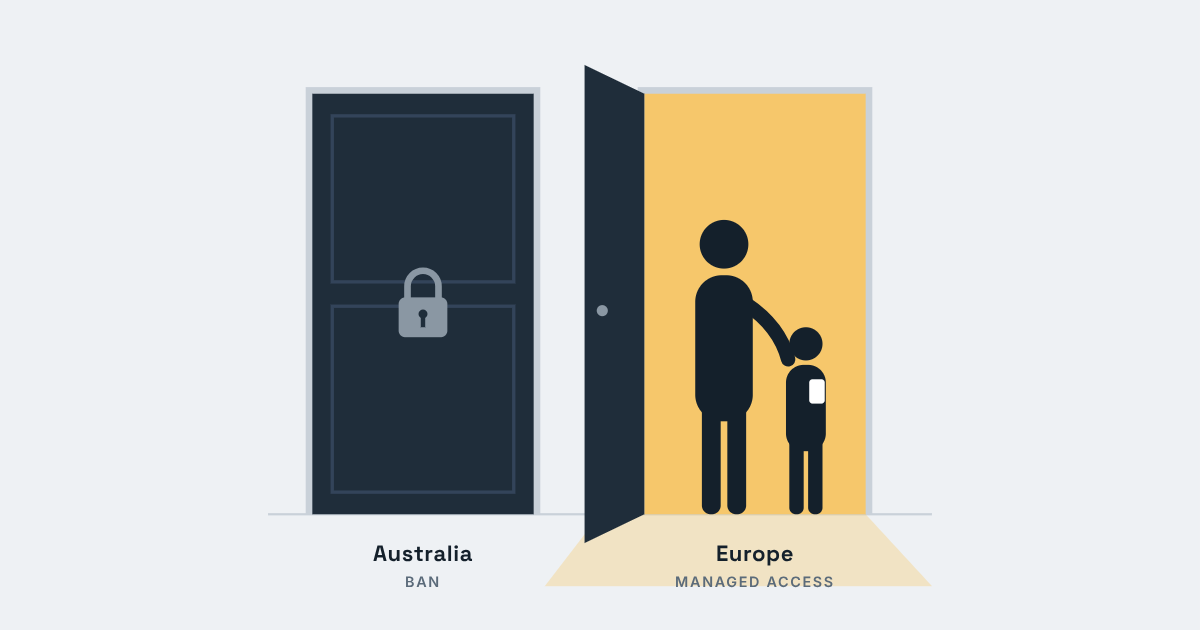
In other words, for the most sensitive years, Europe did not choose no access. It chose managed access, with a parent involved. Earlier this year, Commission President Ursula von der Leyen put the idea well when she said the real question is whether social media should have access to young people, not the other way around.
That is a big shift. It places responsibility on two sides at once: platforms must design safer products, and parents get a real, legal role in their child’s first steps online.
This is not “parents vs. platforms”
I want to be clear about one thing, because it’s an easy argument to misread.
Saying “don’t ban, give parents tools” can sound like “let the platforms off the hook and put everything on parents.” That is not my position.
Parents cannot fix an app that is designed to keep kids scrolling at 2 a.m. That is the platform’s job, and regulation should force it. Europe’s safety-by-design rules, the UK’s Online Safety Act, and similar laws are doing exactly that.
But platforms cannot know your child. They don’t know that she’s had a hard month at school, or that he’s suddenly talking to someone new every night. Parents can.
Safe design from platforms, plus visibility and involvement for parents. Both, together. Not a locked door.
The next test is already here: AI chatbots
If you think this debate is only about Instagram and TikTok, look at what happened last month. On 14 October 2026, eight US states sued OpenAI, claiming ChatGPT exposed children to dangerous conversations, including content linked to self-harm.
AI chatbots and “AI friends” are the next place kids will go, and many parents don’t even think of them as social media. You cannot ban your way out of a technology that is being built into every phone, search engine and homework tool. What you can do is know it’s there, understand how your child uses it, and be close enough to notice when something feels wrong.
That is the same lesson Australia taught us, just one step ahead.
What I’d tell a parent today
- Don’t rely on a law to keep your child off an app. The data shows it probably won’t.
- Know where your kids are online, including games, group chats and AI apps, not just the big social networks.
- Make it safe for them to tell you when something goes wrong, without fear that the first result will be “you’re not allowed to use that.”
- Use the tools that exist, from platform settings to parental tools, as a way to stay involved, not to spy.
- Push for safe design. Support rules that make platforms responsible for what they build.
The bottom line
Australia tried to lock the door. A year later, most kids are still inside, and many of them are now hiding it.
Europe looked at that result and chose to keep the door open, with an adult in the room.
I think Europe got it right. Not because bans are always wrong, but because the goal was never to keep kids off the internet. The goal is to keep them safe on it. And you can’t keep someone safe if you can’t see them.
Sources
- eSafety study: most Australian teens still on social media (The Next Web)
- Australia’s ban stumbles at the first age check (The Next Web)
- 4.7 million accounts removed (Social Media Today)
- Australia doubles fines, warns of court action (The Standard / Reuters)
- Study: ban may work better for younger children (Deseret News)
- European Commission proposes EU KIDS Act (SCL)
- EU KIDS Act overview (Davis Wright Tremaine)
- EU KIDS Act scope incl. games and AI (DLA Piper)
- Von der Leyen on social media age limits (Emirates 24/7)
- Eight US states sue OpenAI (Tech Insider)
- Alternative apps surge as the ban starts (Bloomberg)
- Lemon8 added to the ban after teens flocked to it (The West Australian)
- European Parliament backs a minimum age of 16