
At the Cohen household, there is a long-running debate about the “supreme” mobile operating system. My wife is a devout iPhone user, while I am firmly in the Android camp. Neither of us has successfully converted the other.
These differences are reinforced daily by the distinct User Interfaces of each platform. I find it just as difficult to operate her device as she does mine. It’s a friendly disagreement, and truthfully, we manage to live in peace despite this technological divide.
However, when we shift the context from adults to children, the differences between these two platforms stop being a matter of taste and start being a matter of safety.
As the CEO of PureSight , where we specialize in protecting children online, I see a fundamental contrast in philosophy between the two giants:
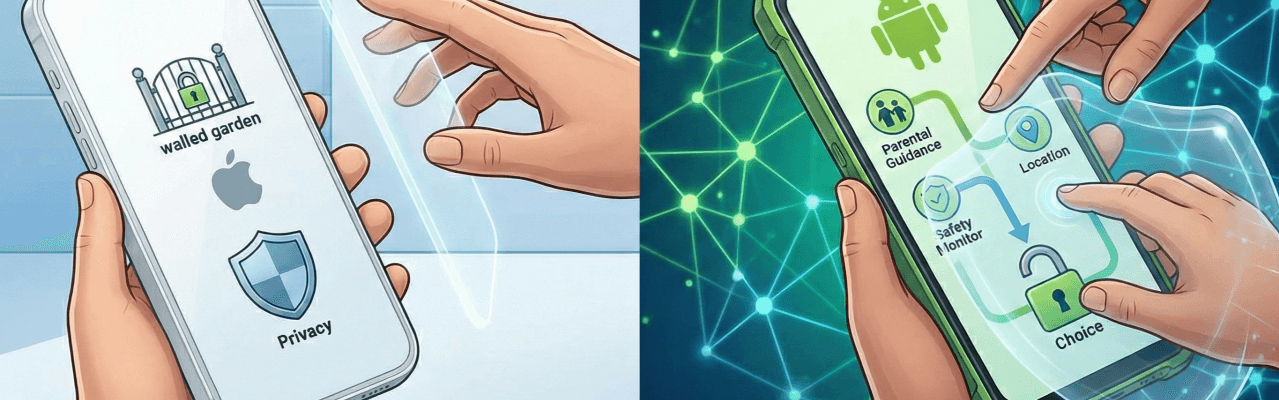
- Apple prioritizes a “walled garden” approach to privacy. While noble in theory, this policy severely limits third-party applications’ ability to provide robust child protection services.
- Google, on the other hand, adopts a policy that balances privacy with parental choice. They have established strict guidelines: apps can request monitoring permissions, but they must transparently explain what is being accessed and why. If a parent chooses to grant those permissions to protect their child, the OS allows it.
The Result: On an Android device, we can run child protection services that are significantly more effective, practical, and deep than what is possible on an iPhone. The proof is in the market – virtually all dedicated “safe phones” for kids available today are built on the Android platform, not iOS.
The Social Pressure vs. Online Child Safety
This creates a massive challenge for parents, particularly in markets like the US where the iPhone is a status symbol. Parents face immense pressure to provide their children with iPhones to avoid social exclusion (the “Green Bubble” stigma). Yet, by doing so, they inadvertently back themselves into a corner with very limited tools to monitor and protect their children in the digital social sphere.
A Regulatory Blind Spot
Current regulatory discussions on child safety are heavily focused on blocking access to social platforms. While well-intentioned, I believe this misses a crucial opportunity.
Instead of just trying to ban usage, regulators should demand that OS providers (specifically Apple) open up their APIs to legitimate child safety vendors. We need the ability to monitor and protect children on the device level – capabilities that the OS providers themselves are not fully offering.
The Privacy Paradox: The Life360 Example
Critics often cite strict privacy as the reason for locking down devices. But do parents actually prefer total privacy over safety?
Look at Life360, a location service with over 90 million users, mostly families. As a public company, they have disclosed that the data collected from their free-tier users (about 97% of their base) is sold to third parties to fund the operation. Despite the known trade-off between privacy and utility, millions of families use it daily.
The lesson? Parents are willing to share data if it means keeping their children safe.
Driving Change: The “First Phone” Opportunity
Let’s be realistic: attempting to switch a teenager from an iPhone to an Android is virtually a “mission impossible” due to social dynamics. However, parents hold the power when purchasing the very first smartphone, typically around age 10.
This is the precise moment when children take their first steps into the digital world, a critical stage where deep parental involvement and guidance are essential, not optional. Therefore, I strongly recommend utilizing this window of opportunity to ensure their first device is Android-based. It is the most effective way to guarantee you have the necessary tools to guide and protect them during these formative years.
Let’s prioritize safety over status.