

🎮 Games, Manipulation, and Our Role as Digital Parents
In 2024, over 3.3 billion people around the world played video games. Games have become one of the most dominant entertainment platforms globally — enjoyed by children, teens, and adults alike. They are exciting, interactive, and often social. But beneath the fun, there’s a serious problem that many parents, and even regulators, are only beginning to truly understand.
Earlier this year, between March 31 and April 11, 2025, the International Consumer Protection and Enforcement Network (ICPEN) conducted a global sweep of 439 mobile and online games. The results were alarming.
🧠 What They Found: Games Use Manipulation by Design
ICPEN’s sweep revealed that many games use manipulative design techniques – psychological tactics built into the game experience to keep players engaged longer and spending more. These methods are used on all players, but they’re especially dangerous for children.
The most common tactics included:
- Sneaking – hiding critical information from players (like costs or limits).
- Nagging – constant reminders or pressure to make in-game purchases.
- Obstruction – making it hard to skip or avoid certain actions unless you pay or wait.
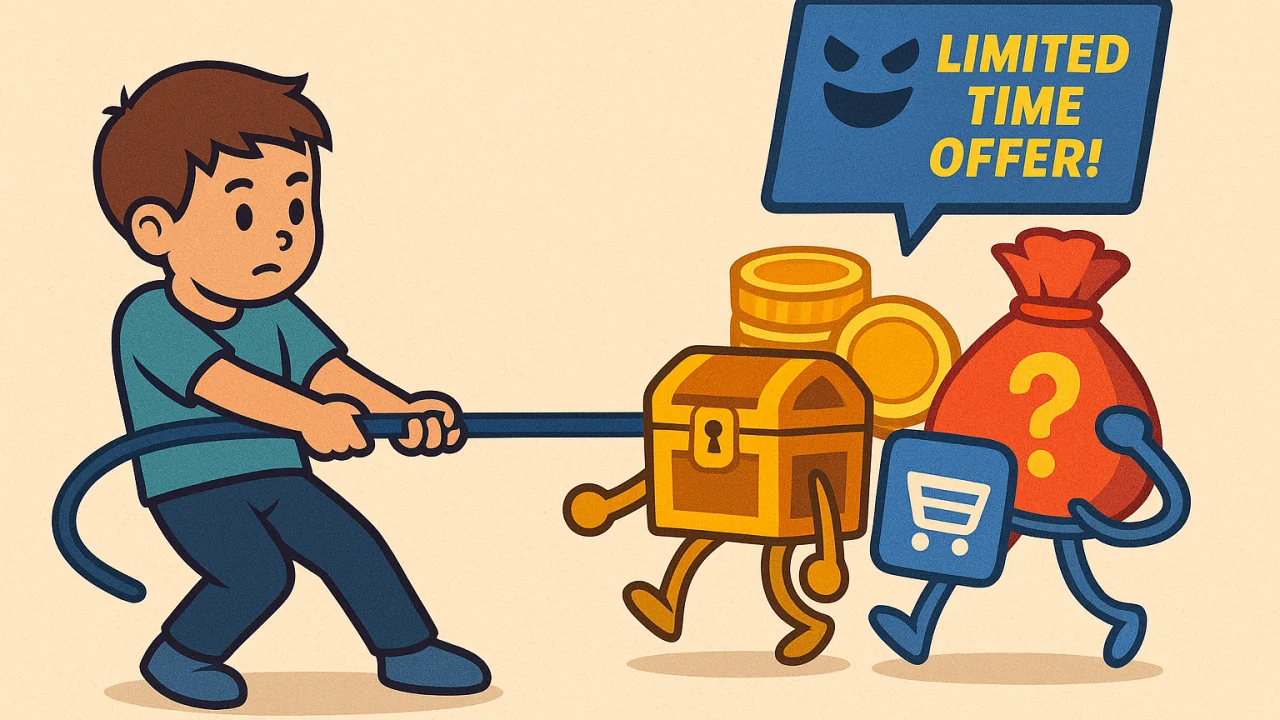
In addition, many games use “urgency tricks”, messages like “Limited Time Offer” or “Only 2 Left!” to make players feel like they have to act fast. ICPEN found that some of these offers were not even real; they were just pressure tactics.
🎮 Even Games for 3-Year-Olds Use These Tricks
What’s perhaps most disturbing is that these manipulative techniques aren’t just in games for teenagers or adults. ICPEN found that:
- Loot boxes, in-game purchases, and ads are just as common in games rated for ages 3 and up as in other games.
- Only 30% of games that included loot boxes actually disclosed this in the game’s download page or description.
So not only are our kids exposed to this, we often don’t even know it’s happening.
👨👩👧👦 Our Kids Are Up Against Experts. They Need Us.
As parents, we must face a difficult truth: When our children play these games, they are not just having fun. They are being influenced by teams of professionals, game designers, behavioral scientists, and monetization experts, all working to keep them playing and spending.
It’s not a fair fight. Our kids are just kids. They don’t know how to resist these tactics, and why should they? Even adults often fall into the same traps.
That’s why we, the parents, need to step in.
We must:
- Know how much time our children spend on screens.
- Understand what they’re doing during that time.
- Talk to them openly about what’s okay and what’s not.
- Help them break habits that lead to addiction or overspending.
🧭 But That’s Easier Said Than Done
The truth is, today’s parents are dealing with challenges that didn’t exist a generation ago. Give a child a smartphone, and in seconds, they can access games, chat with strangers, or be exposed to content we wouldn’t approve of, all from the safety of the living room couch.
You don’t see who they’re talking to. You don’t hear what they’re seeing. And unless you have tools in place, you may not even know how much time they’re online.
🛡️ Digital Parenting Tools Are No Longer Optional
At PureSight , we’ve made it our mission to help families take back control. Not by spying on children, but by giving parents real visibility and the ability to have open, meaningful conversations with their kids.
We believe that:
- Screen time tracking should be standard in every household.
- Parents should be able to see what their kids are exposed to, and decide what’s appropriate.
- And most of all, children deserve to be protected, not manipulated.
This is not about control. It’s about guidance, responsibility, and care.
🔚 We Can’t Change the Whole Digital World – But We Can Change How We Parent in It
The digital world isn’t going away. If anything, it’s only becoming more immersive, more targeted, and more complex.
But that doesn’t mean we’re powerless. It means we must adapt, as parents, as educators, and as a society.
Let’s stop pretending that a simple parental warning or a 3+ age rating is enough. Let’s give our children the tools, support, and protection they need to grow up safe and strong in the digital world.
And let’s start today.