

Recently,Lori Fullbright, News On 6 Anchor & Crime Reporter, shared a clear and important breakdown of the actual scripts predators use during online grooming, how they initiate contact with children on social platforms, how trust is slowly built, how manipulation escalates, and where it can ultimately lead.
What stood out most is something many parents, and even professionals, underestimate:
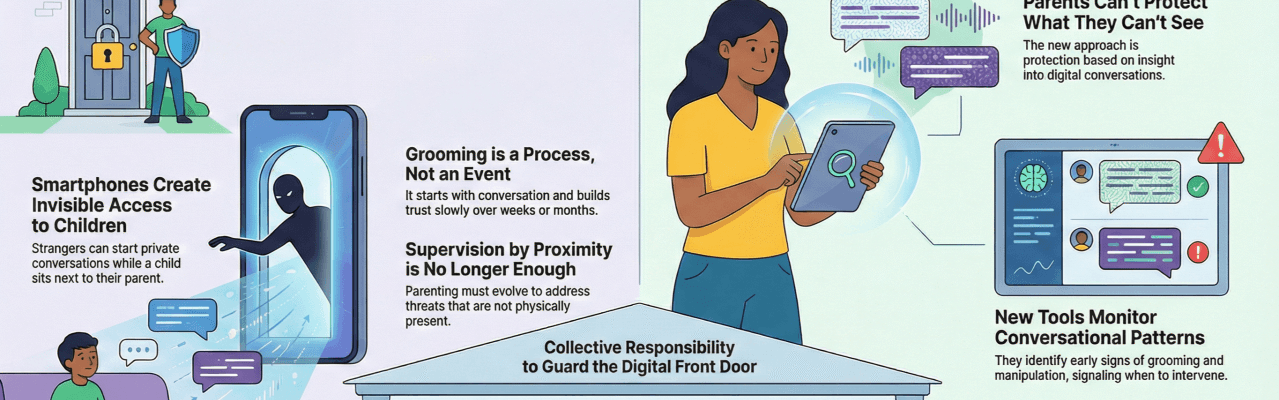
Grooming is a process, not an event. It doesn’t happen in a single message. It can take weeks or months for the situation to become visibly dangerous.
That delay is exactly what makes it so effective, and so hard to detect.
Here’s the uncomfortable reality of modern parenting:
The moment we give a child a smartphone and access to social platforms, we’ve effectively createda virtual front door with a public sign.
Strangers don’t need to pass through our home. They don’t need to meet us. They can start a direct, private conversation with our childwhile the child is sitting right next to us on the couch.
This invisible access gap is one of the defining challenges of parenting in the digital age.
And it’s precisely the problem that led us to build Surfie.
Surfie was designed around a simple but powerful idea: Parents can’t protect what they can’t see.
By monitoring conversational patterns across social platforms and identifying early signs of grooming and manipulation, Surfie helps parents know when awareness is enough and when intervention is required.
Yes, delaying young children’s entry into social platforms is ideal. But it’s no longer sufficient.
Social platforms are embedded in daily life. Which means parenting itself must evolve , from supervision based on proximity, to protection based on insight.
Thought leadership today isn’t about asking whether kids should be online. It’s about asking whether we’re giving parents the tools they need once they are.
🔔 Call to Action – Responsibility Looks Different for Each of Us
This conversation matters, but the responsibility looks different for each of us:
👨👩👧 Parents
- 👉 Start conversations early, before the first red flag appears
- 👉 Stay involved beyond screen-time rules
- 👉 Don’t assume physical proximity equals digital safety
🏫 Educators
- 👉 Align regulation with how children actually communicate today
- 👉 Shift focus from reaction to prevention
🛡️Insurers
- 👉 Treat online harm as a preventable risk, not just a claim
- 👉 Invest in early-detection and family-protection models
🧠 Platform Leaders
- 👉 Design child safety as a default, not an add-on
- 👉 Detect grooming patterns early, before escalation
Let’s stop reacting late and start preventing early.
Because online safety doesn’t fail suddenly.
It fails slowly, when no one is watching.