

The iPhone vs. Android Debate: It’s Not Just About Preference, It’s About Our Children’s Safety

<< All Resources
Share:

At the Cohen household, there is a long-running debate about the “supreme” mobile operating system. My wife is a devout iPhone user, while I am firmly in the Android camp. Neither of us has successfully converted the other.

These differences are reinforced daily by the distinct User Interfaces of each platform. I find it just as difficult to operate her device as she does mine. It’s a friendly disagreement, and truthfully, we manage to live in peace despite this technological divide.

However, when we shift the context from adults to children, the differences between these two platforms stop being a matter of taste and start being a matter of safety.

As the CEO of PureSight , where we specialize in protecting children online, I see a fundamental contrast in philosophy between the two giants:

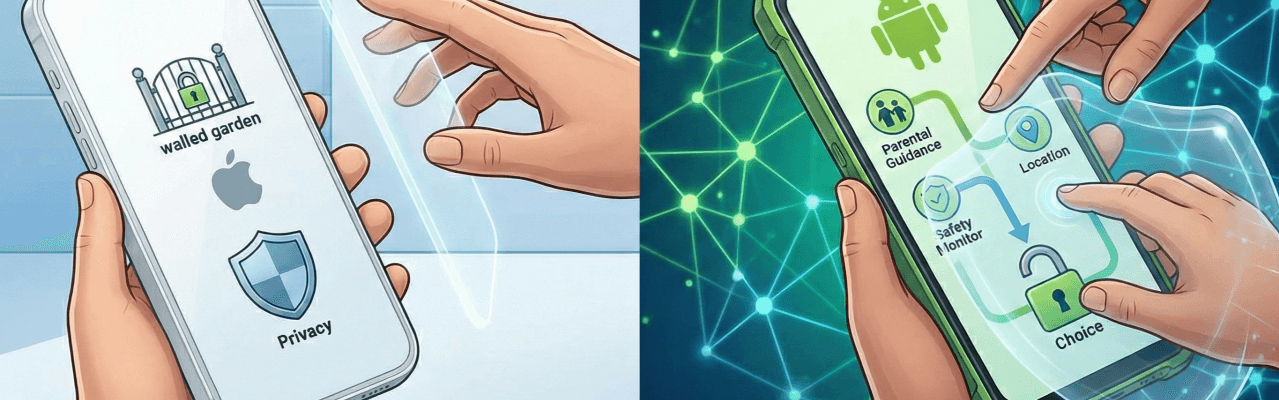
  • Apple prioritizes a “walled garden” approach to privacy. While noble in theory, this policy severely limits third-party applications’ ability to provide robust child protection services.
  • Google, on the other hand, adopts a policy that balances privacy with parental choice. They have established strict guidelines: apps can request monitoring permissions, but they must transparently explain what is being accessed and why. If a parent chooses to grant those permissions to protect their child, the OS allows it.

The Result: On an Android device, we can run child protection services that are significantly more effective, practical, and deep than what is possible on an iPhone. The proof is in the market – virtually all dedicated “safe phones” for kids available today are built on the Android platform, not iOS.

The Social Pressure vs. Online Child Safety

This creates a massive challenge for parents, particularly in markets like the US where the iPhone is a status symbol. Parents face immense pressure to provide their children with iPhones to avoid social exclusion (the “Green Bubble” stigma). Yet, by doing so, they inadvertently back themselves into a corner with very limited tools to monitor and protect their children in the digital social sphere.

A Regulatory Blind Spot

Current regulatory discussions on child safety are heavily focused on blocking access to social platforms. While well-intentioned, I believe this misses a crucial opportunity.

Instead of just trying to ban usage, regulators should demand that OS providers (specifically Apple) open up their APIs to legitimate child safety vendors. We need the ability to monitor and protect children on the device level – capabilities that the OS providers themselves are not fully offering.

The Privacy Paradox: The Life360 Example

Critics often cite strict privacy as the reason for locking down devices. But do parents actually prefer total privacy over safety?

Look at Life360, a location service with over 90 million users, mostly families. As a public company, they have disclosed that the data collected from their free-tier users (about 97% of their base) is sold to third parties to fund the operation. Despite the known trade-off between privacy and utility, millions of families use it daily.

The lesson? Parents are willing to share data if it means keeping their children safe.

Driving Change: The “First Phone” Opportunity

Let’s be realistic: attempting to switch a teenager from an iPhone to an Android is virtually a “mission impossible” due to social dynamics. However, parents hold the power when purchasing the very first smartphone, typically around age 10.

This is the precise moment when children take their first steps into the digital world, a critical stage where deep parental involvement and guidance are essential, not optional. Therefore, I strongly recommend utilizing this window of opportunity to ensure their first device is Android-based. It is the most effective way to guarantee you have the necessary tools to guide and protect them during these formative years.

Let’s prioritize safety over status.

Digital Parenting, online child safety, safe internet use, social media

Why “Parental Control” Is No Longer Enough – And Why We Must Shift to Online Child Safety

<< All Resources
Share:

In marketing, we know that when a product enters a new market first, its name often becomes the name of the entire category. Think of Zoom, it became the generic term for video conferencing, even when people were actually using Teams, Google Meet, or another platform.

In the world of child protection online, a similar thing happened. For many years, the category has been known as “Parental Control.” It’s a term born in the early days of the industry, when solutions focused mainly on web content filtering.

But after more than a decade in this field, and as a father of four (not so little) kids. I’ve never truly connected to the idea that a parent’s role is to control their children.

Our children are not robots. And I don’t believe that controlling them is the goal. Our role as parents is to educate, guide, and protect, while helping them gradually grow into independent, responsible digital citizens.

We Chose a New Term: “Online Child Safety Service”

At PureSight, we have chosen to move away from the old terminology. We refer to our solution as an Online Child Safety Service, because it reflects what modern families actually need today:

  • Not control.
  • Not restriction for the sake of restriction.
  • But involvement, awareness, and timely guidance.

The digital world has changed dramatically. If once the main risk was inappropriate websites, today the challenge is very different:

  • 📱 Kids spend far less time “browsing the internet.”
  • 📲 And significantly more time inside dedicated social, gaming, and messaging platforms.

This shift created an entirely new reality for parents.

The New Parenting Challenge

Every parent knows this moment:

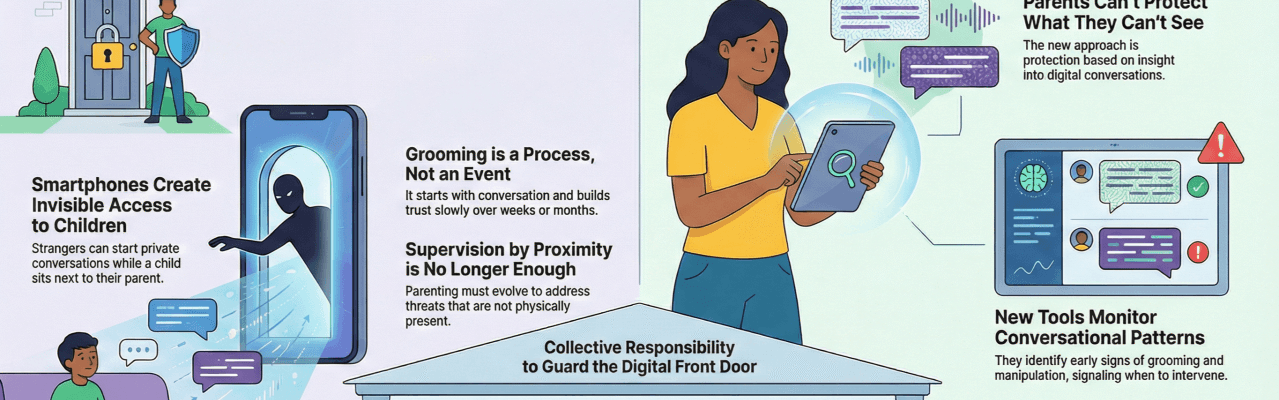
You’re sitting in the living room with your child. They are next to you, holding a smartphone. Yet you have no idea:

  • Who they are talking to
  • What content they’re seeing
  • What conversations they are involved in
  • Or what is happening inside those apps

This lack of parental visibility is not a small issue. It removes a parent’s ability to guide, support, and protect. And that is a fundamental problem.

Regulation Is Coming – But Often Focused on Yesterday’s Problems

Across the world, more governments are realizing their responsibility to protect children online. This is encouraging, but many of these regulatory efforts still focus on yesterday’s challenges:

  • Traditional content filtering
  • Age-based blocking of entire platforms
  • Attempts to isolate children from digital life altogether

But as I’ve said before: I don’t believe full isolation is the answer.

Social platforms are the “digital roads” of our time. Just like real roads, we can’t keep children away from them forever.

  • We don’t ban kids from crossing the street.
  • We teachthem how to cross safely.
  • We hold their handwhen they’re young.
  • And gradually, as they mature, they learn to navigate it on their own.

The digital world demands the same approach.

Modern Child Safety Must Focus on Social Platforms

To truly protect children today, safety solutions must be able to:

     ✔️ Monitor online interactions in social platforms
     ✔️ Detect risks early
     ✔️ Alert parents when intervention is needed

Because the real threats today are:

  • Cyberbullying
  • Predators initiating contact with children
  • Harmful content and dangerous trends
  • Emotional pressure or manipulation
  • Exposure to age-inappropriate material

Parents don’t need to “control” their kids.

  • They need awareness.
  • They need timely information.
  • They need the ability to remain involved, without intruding, and without breaking trust.

Our Mission at PureSight

At PureSight , this has been our mission from day one:

To empower parents with the right insights at the right time , so they can protect, guide, and support their children in the digital world.

Not through control. But through smart, AI-driven, respectful, and age-appropriate guidance.

As the digital world continues to evolve, so must the tools and language we use to keep our children safe.

And it starts by letting go of old terminology, and embracing the real challenge of our time: Online Child Safety.

If you’d like to explore how we support millions of families worldwide with AI-powered child protection, I’d be happy to connect.


Royi Cohen

CEO @ PureSight | Global expert on Online Child Safety, developing platforms and services for the global market.
Cyberbullying, Digital Parenting, online child safety, Online predators, safe internet use

🎮 Games, Manipulation, and Our Role as Digital Parents

<< All Resources
Share:

🎮 Games, Manipulation, and Our Role as Digital Parents

In 2024, over 3.3 billion people around the world played video games. Games have become one of the most dominant entertainment platforms globally — enjoyed by children, teens, and adults alike. They are exciting, interactive, and often social. But beneath the fun, there’s a serious problem that many parents, and even regulators, are only beginning to truly understand.

Earlier this year, between March 31 and April 11, 2025, the International Consumer Protection and Enforcement Network (ICPEN) conducted a global sweep of 439 mobile and online games. The results were alarming.

🧠 What They Found: Games Use Manipulation by Design

ICPEN’s sweep revealed that many games use manipulative design techniques – psychological tactics built into the game experience to keep players engaged longer and spending more. These methods are used on all players, but they’re especially dangerous for children.

The most common tactics included:

  • Sneaking – hiding critical information from players (like costs or limits).
  • Nagging – constant reminders or pressure to make in-game purchases.
  • Obstruction – making it hard to skip or avoid certain actions unless you pay or wait.

In addition, many games use “urgency tricks”, messages like “Limited Time Offer” or “Only 2 Left!” to make players feel like they have to act fast. ICPEN found that some of these offers were not even real; they were just pressure tactics.

🎮 Even Games for 3-Year-Olds Use These Tricks

What’s perhaps most disturbing is that these manipulative techniques aren’t just in games for teenagers or adults. ICPEN found that:

  • Loot boxes, in-game purchases, and ads are just as common in games rated for ages 3 and up as in other games.
  • Only 30% of games that included loot boxes actually disclosed this in the game’s download page or description.

So not only are our kids exposed to this, we often don’t even know it’s happening.

👨👩👧👦 Our Kids Are Up Against Experts. They Need Us.

As parents, we must face a difficult truth: When our children play these games, they are not just having fun. They are being influenced by teams of professionals, game designers, behavioral scientists, and monetization experts, all working to keep them playing and spending.

It’s not a fair fight. Our kids are just kids. They don’t know how to resist these tactics, and why should they? Even adults often fall into the same traps.

That’s why we, the parents, need to step in.

We must:

  • Know how much time our children spend on screens.
  • Understand what they’re doing during that time.
  • Talk to them openly about what’s okay and what’s not.
  • Help them break habits that lead to addiction or overspending.

🧭 But That’s Easier Said Than Done

The truth is, today’s parents are dealing with challenges that didn’t exist a generation ago. Give a child a smartphone, and in seconds, they can access games, chat with strangers, or be exposed to content we wouldn’t approve of, all from the safety of the living room couch.

You don’t see who they’re talking to. You don’t hear what they’re seeing. And unless you have tools in place, you may not even know how much time they’re online.

🛡️ Digital Parenting Tools Are No Longer Optional

At PureSight , we’ve made it our mission to help families take back control. Not by spying on children, but by giving parents real visibility and the ability to have open, meaningful conversations with their kids.

We believe that:

  • Screen time tracking should be standard in every household.
  • Parents should be able to see what their kids are exposed to, and decide what’s appropriate.
  • And most of all, children deserve to be protected, not manipulated.

This is not about control. It’s about guidance, responsibility, and care.

🔚 We Can’t Change the Whole Digital World – But We Can Change How We Parent in It

The digital world isn’t going away. If anything, it’s only becoming more immersive, more targeted, and more complex.

But that doesn’t mean we’re powerless. It means we must adapt, as parents, as educators, and as a society.

Let’s stop pretending that a simple parental warning or a 3+ age rating is enough. Let’s give our children the tools, support, and protection they need to grow up safe and strong in the digital world.

And let’s start today.

Royi Cohen

CEO @ PureSight | Global expert on Online Child Safety, developing platforms and services for the global market.
Digital Parenting, online child safety, prevention, screen addiction, time limits
Don’t wait, Schedule Puresight demo today!